




ORGANS OF PARIS © 2026 Vincent Hildebrandt HOME ALL ORGANS
Schola Cantorum
269, rue Saint Jacques, 75005 Paris


The story of the Schola Cantorum is, first and foremost,
the story of one man’s determination: Charles Bordes.
He began laying the foundations of his vision as early as
1890. In 1894, he gathered a group of friends,
benefactors, and shareholders to create a society under
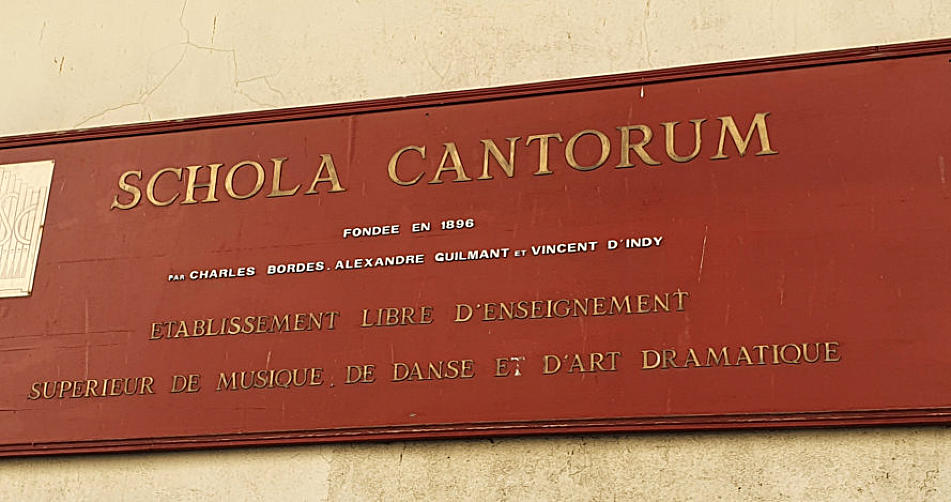
the name Schola Cantorum. Among his first
collaborators were two great musicians whose
reputation lent authority and prestige to his project:
Alexandre Guilmant and Vincent d’Indy (1851–1931).
The school officially opened its doors on 15 October
1896 on Rue Stanislas in the Montparnasse district. In
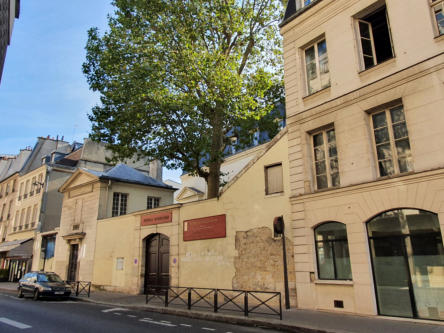
1900, it moved permanently to the Latin Quarter, at 269
Rue Saint-Jacques, into the former convent of the
English Benedictines, built between 1674 and 1677.
A true “free conservatory”—free because personal
expression and individual creativity are respected—the
Schola Cantorum offers teaching for students from all
over the world. Its courses are open to a wide audience
of mixed ages and ambitions, accessible to all levels,
from beginners to concert performers.

E6
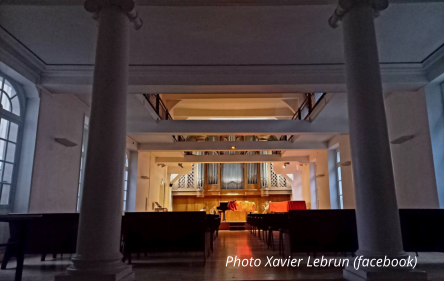
The organ is built by Charles Mutin in 1902 and placed in
the old chapel of the convent, which was transformed
into a concert-hall (III/30). It then comprised 30 stops (26
actual and 4 borrowed), distributed over three manuals
and a pedalboard. The action is mechanical, with a Barker
lever for the Grand-Orgue.
During 1960-1967, the Beuchet company carried out
major works:
•
the Barker machine was replaced by electrical
traction
•
GO: transformation of the Flûte octaviante 4 into a
Flûte douce 4; the Trompette was replaced by a
Doublette
•
Récit: transformation of the Flûte traversière into a
Flûte douce 8 and the Flûte octaviante 4 into a Flûte
douce 4; the Basson 16 was replaced by a Flageolet
•
Positif: Salicional 8 replaced by a Principal 4;
Clarinette and Cromorne were revoiced
•
Pedal: Bombarde 16 was replaced by the Trompette
8 from the GO.
In 1987, Barbéris added a Plein jeu IV on the GO and the
Flûte douce 4 of the Récit was transformed again into a
Flûte octaviante. He installed also a new standard pedal.
In 1997/2011/2013, works were done by Dargassies. In
2011, the pedal was electrified and in 2013 the primary
blowers were replaced.


1902 - Cavaillé-Coll-Mutin (1)
1960/67 - Beuchet (3a)
1987 - Barbéris (6)
1997/2011/2013 - Dargassies (6)
III/31 (27) -
mechanical traction (pédale, stops)
electrical traction (manuals)
stoplist



Organ teachers
David Cassan, Jean Galard, Françoise Levéchin-
Gangloff, Henri Paget, Marc Sacrispeyre
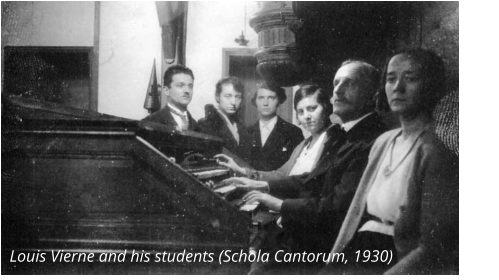
Famous teachers in the past: Alexandre Guilmant, Vincent
d'Indy, Maurice and Marie-Madeleine Durufle, Jean-
Jacques Grunenwald, Louis Vierne, Jean Langlais.
Famous students: Maurice Duruflé, Jean-Jacques
Grunenwald, Jean Langlais, Daniel Lesur, Olivier
Messiaen, Déodat de Séverac, Louis Vierne…
Site
Video
Jean-Paul Imbert
Photos
Orgue : Peter Hammer








The organs of Paris
Schola Cantorum
269, rue Saint Jacques, 75005 Paris


ORGANS OF PARIS © 2026 Vincent Hildebrandt
E6
The organ is built by Charles Mutin in 1902 and placed in the
old chapel of the convent, which was transformed into a
concert-hall (III/30). It then comprised 30 stops (26 actual
and 4 borrowed), distributed over three manuals and a
pedalboard. The action is mechanical, with a Barker lever for
the Grand-Orgue.
During 1960-1967, the Beuchet company carried out major
works:
•
the Barker machine was replaced by electrical traction
•
GO: transformation of the Flûte octaviante 4 into a Flûte
douce 4; the Trompette was replaced by a Doublette
•
Récit: transformation of the Flûte traversière into a
Flûte douce 8 and the Flûte octaviante 4 into a Flûte
douce 4; the Basson 16 was replaced by a Flageolet
•
Positif: Salicional 8 replaced by a Principal 4; Clarinette
and Cromorne were revoiced
•
Pedal: Bombarde 16 was replaced by the Trompette 8
from the GO.
In 1987, Barbéris added a Plein jeu IV on the GO and the
Flûte douce 4 of the Récit was transformed again into a Flûte
octaviante. He installed also a new standard pedal.
In 1997/2011/2013, works were done by Dargassies. In 2011,
the pedal was electrified and in 2013 the primary blowers
were replaced.


1902 - Cavaillé-Coll-Mutin (1)
1960/67 - Beuchet (3a)
1987 - Barbéris (6)
1997/2011/2013 - Dargassies (6)
III/31 (27) -
mechanical traction (pédale, stops)
electrical traction (manuals)
stoplist
Organ teachers
David Cassan, Jean Galard, Françoise Levéchin-Gangloff,
Henri Paget, Marc Sacrispeyre
Famous teachers in the past: Alexandre Guilmant, Vincent
d'Indy, Maurice and Marie-Madeleine Durufle, Jean-Jacques
Grunenwald, Louis Vierne, Jean Langlais.
Famous students: Maurice Duruflé, Jean-Jacques Grunenwald,
Jean Langlais, Daniel Lesur, Olivier Messiaen, Déodat de
Séverac, Louis Vierne…
Site
Video
Jean-Paul Imbert
Photos
Orgue : Peter Hammer
E6
The organ is built by Charles Mutin in 1902 and placed in the
old chapel of the convent, which was transformed into a
concert-hall (III/30). It then comprised 30 stops (26 actual
and 4 borrowed), distributed over three manuals and a
pedalboard. The action is mechanical, with a Barker lever for
the Grand-Orgue.
During 1960-1967, the Beuchet company carried out major
works:
•
the Barker machine was replaced by electrical traction
•
GO: transformation of the Flûte octaviante 4 into a Flûte
douce 4; the Trompette was replaced by a Doublette
•
Récit: transformation of the Flûte traversière into a
Flûte douce 8 and the Flûte octaviante 4 into a Flûte
douce 4; the Basson 16 was replaced by a Flageolet
•
Positif: Salicional 8 replaced by a Principal 4; Clarinette
and Cromorne were revoiced
•
Pedal: Bombarde 16 was replaced by the Trompette 8
from the GO.
In 1987, Barbéris added a Plein jeu IV on the GO and the
Flûte douce 4 of the Récit was transformed again into a Flûte
octaviante. He installed also a new standard pedal.
In 1997/2011/2013, works were done by Dargassies. In 2011,
the pedal was electrified and in 2013 the primary blowers
were replaced.

