




ORGANS OF PARIS © 2026 Vincent Hildebrandt HOME ALL ORGANS



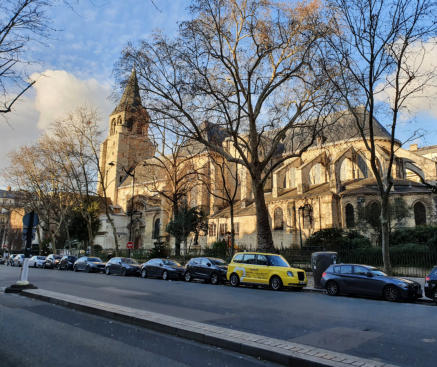
Saint-Germain-des-Prés, dating back to the 6th century,
is Paris's oldest church. Originally, this former
Benedictine abbey was founded by Childebert, son of
Clovis. In the Middle Ages, the abbey was very powerful
thanks to its thriving activities. The Normans destroyed
it several times. The introduction of the Maurist reform
in 1630 turned it into a major center of learning with
international influence. But the French Revolution led
to the suppression of all abbeys, and for Saint-Germain-
des-Prés, the end came on February 13, 1792. The
church then became a saltpeter factory, and worship
was only restored on April 29, 1803. Since then, it has
served solely as a parish church.
Between 1821 and 1854, the church—badly damaged
during the revolutionary period—was restored by
architects Étienne-Hippolyte Godde and Victor Baltard.
They kept just one of the three original Romanesque
towers. Hippolyte Flandrin, a student of the classical
master Ingres, was commissioned to paint the nave
murals, which were recently restored.
The current building is a fine example of Romanesque
architecture, especially its tower and nave. The choir is
Gothic. Saint-Germain-des-Prés is the oldest of Paris's
major churches and remains at the heart of a lively,
dynamic parish today.

A5
In 1805, the Saint-Germain parish acquired the organ from
the Abbey of Saint-Victor. The previous organ by Pierre and
Alexandre Thierry (1667) had been dismantled in 1798 and
moved to Saint-Eustache, where it burned in 1844.
1679
The Abbey of Saint-Victor organ was built by Alexandre
Thierry.
1759/1779
Major restoration by Louis-Alexandre and François-Henri
Clicquot; the organ was overhauled and modernized by
swapping out just a few stops.
1797
When the revolutionaries closed the abbey church, the organ
was crated up and stored at the Conservatoire des Arts et
Métiers.
1805–1810
It was installed at Saint-Germain-des-Prés between 1805 and
1810 by Antoine and Louis Somer. The case was rebuilt to fit
the gallery and low vault of Saint-Germain, while largely
preserving Thierry and Clicquot’s original pipework.
1829
It was overhauled by Louis Callinet (with a few new stops
added).
1862
Jean-Baptiste Stoltz completely rebuilt it in 1862 within the
large case, without a rear Positive division. Architect Baltard
reconstructed the gallery. The symphonic-style organ had
three manuals and pedal (47 stops), with the Positive placed
behind the new Swell to make it expressive too.
1922–27
Joseph Gutschenritter rebuilt it entirely again, under the
direction of André Marchal, who shifted its sound toward a
neo-classical aesthetic.
1970–1973
A major restoration became essential due to the
instrument’s worsening condition. Maison Haerpfer-Erman
was commissioned to build a new organ in a French neo-
classical style, incorporating 10 historic stops and restoring
the rear Positive.
1991
Overhauled by Yves Fossaert.
2004–2005
Restored by Yves Fossaert.
The Great manual’s case dates from 1810, the Positive’s from
1973. The statues atop the case are the only surviving
remnants of the original Saint-Victor Abbey organ. Four stops
come from the old Saint-Victor organ, 17 from the Somer
organ, and 19 are new.
This organ is unique in Paris: it’s built in a neo-classical style that
favors French classical organ repertoire over German music,
while still allowing symphonic works on the expansive Great
Swell. The church has excellent acoustics.
Read more (in French)


Titular organist
Anne-Marie Blondel, Jean-Paul Serra
Organistes célèbres ayant illustré l’instrument : Antoine
Calvière, J.M. Beauvarlet-Charpentier, Augustin Barié,
André Marchal, André Isoir.
Parish website
Videos
Anne-Marie Blondel
Jean Luc Ho
Odile Bailleux (1986) (audio)
Odile Bailleux (1986) (audio)
Photos
Buffet : Jeroen de Haan
1679 - Alexandre Thierry (1)
1759 - Louis-Alexandre Clicquot (3a)
1779 - François-Henri Clicquot (3a)
1810 - Antoine et Louis Somer (5)
1829 - Louis Callinet (5)
1863 - Stolz (3a)
1927 - Gutenschenritter (3a)
1973 - Haerpfer-Ermann (3)
1991 - Yves Fossaert (6)
2005 - Yves Fossaert (5)
IV/56 - mechanical traction
Stoplist








The organs of Paris


ORGANS OF PARIS © 2026 Vincent Hildebrandt
A5
In 1805, the Saint-Germain parish acquired the organ from the
Abbey of Saint-Victor. The previous organ by Pierre and
Alexandre Thierry (1667) had been dismantled in 1798 and
moved to Saint-Eustache, where it burned in 1844.
1679
The Abbey of Saint-Victor organ was built by Alexandre Thierry.
1759/1779
Major restoration by Louis-Alexandre and François-Henri
Clicquot; the organ was overhauled and modernized by
swapping out just a few stops.
1797
When the revolutionaries closed the abbey church, the organ
was crated up and stored at the Conservatoire des Arts et
Métiers.
1805–1810
It was installed at Saint-Germain-des-Prés between 1805 and
1810 by Antoine and Louis Somer. The case was rebuilt to fit
the gallery and low vault of Saint-Germain, while largely
preserving Thierry and Clicquot’s original pipework.
1829
It was overhauled by Louis Callinet (with a few new stops
added).
1862
Jean-Baptiste Stoltz completely rebuilt it in 1862 within the
large case, without a rear Positive division. Architect Baltard
reconstructed the gallery. The symphonic-style organ had three
manuals and pedal (47 stops), with the Positive placed behind
the new Swell to make it expressive too.
1922–27
Joseph Gutschenritter rebuilt it entirely again, under the
direction of André Marchal, who shifted its sound toward a
neo-classical aesthetic.
1970–1973
A major restoration became essential due to the instrument’s
worsening condition. Maison Haerpfer-Erman was
commissioned to build a new organ in a French neo-classical
style, incorporating 10 historic stops and restoring the rear
Positive.
1991
Overhauled by Yves Fossaert.
2004–2005
Restored by Yves Fossaert.
The Great manual’s case dates from 1810, the Positive’s from
1973. The statues atop the case are the only surviving
remnants of the original Saint-Victor Abbey organ. Four stops
come from the old Saint-Victor organ, 17 from the Somer
organ, and 19 are new.
This organ is unique in Paris: it’s built in a neo-classical style that
favors French classical organ repertoire over German music, while
still allowing symphonic works on the expansive Great Swell. The
church has excellent acoustics.
Read more (in French)


1679 - Alexandre Thierry (1)
1759 - Louis-Alexandre Clicquot (3a)
1779 - François-Henri Clicquot (3a)
1810 - Antoine et Louis Somer (5)
1829 - Louis Callinet (5)
1863 - Stolz (3a)
1927 - Gutenschenritter (3a)
1973 - Haerpfer-Ermann (3)
1991 - Yves Fossaert (6)
2005 - Yves Fossaert (5)
IV/56 - mechanical traction
Stoplist
Titular organist
Anne-Marie Blondel, Jean-Paul Serra
Organistes célèbres ayant illustré l’instrument : Antoine
Calvière, J.M. Beauvarlet-Charpentier, Augustin Barié, André
Marchal, André Isoir.
Parish website
Videos
Anne-Marie Blondel
Jean Luc Ho
Odile Bailleux (1986) (audio)
Odile Bailleux (1986) (audio)
Photos
Buffet : Jeroen de Haan

