




ORGANS OF PARIS © 2026 Vincent Hildebrandt HOME ALL ORGANS




C1
This instrument, whose origins probably go back to the
early 1850s, was originally a rather modest organ with
two manuals (a 54‑note Great Organ and a 49‑note
Récit), built to decorate the drawing room of a wealthy
parishioner who later gave it to Saint‑Jean‑Baptiste de
La Salle. Although the original builder is still uncertain, it
seems likely that the organ was built by Merklin in the
1850s.
Around the 1870s, the organ was enlarged with an
expressive Positif manual composed of stops typical of
Merklin’s style.
Later additions appear to date from its installation in
the church in 1910.
The organ was restored by Jacques Barberis in 1981 and
then by Bernard Dargassies in 2002.
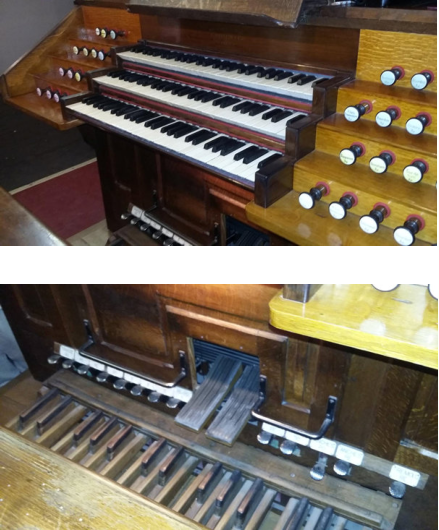
The action is mechanical, with a Barker machine
assisting the Great Organ. The console is detached,
positioned so that the organist faces the instrument.
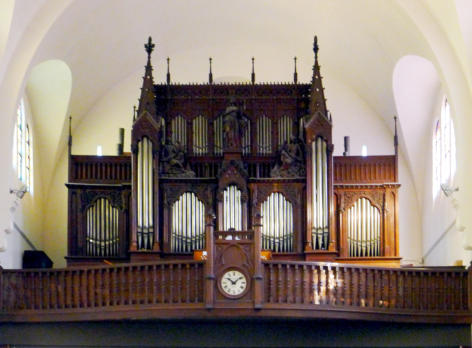
The oak case, finished in polished varnish, consists of a
two‑level central section and two slightly recessed
wings. Besides the two seated angels flanking the main
towers, particular attention should be paid to the statue
crowning the central front case: it is a life‑size figure of
Saint Cecilia.
Text: Thierry Correard



1855 - Merklin (1)
1870 - Merklin (2)
1910 - Gutschenritter (2)
1981 - Barbéris (6)
2002 - Dargassies (6)
III/28 - mechanical traction
Stoplist
Saint-Jean-Baptiste de la Salle, built between 1908 and
1910 by the architect Édouard Jacquemin, is one of
the very first churches erected after the separation of
Church and State. With a barrel‑vaulted nave, the
interior style draws inspiration from Romanesque art
without following any particular school. The pure
white of the vault highlights beautiful stained‑glass
windows that depict the key episodes in the life of
Jean‑Baptiste de La Salle.
The mosaic on the triumphal arch that decorates the
apse and is dedicated to the glory of Christ and of
Jean‑Baptiste de La Salle is beautidful. It is the work of
Marcel Imbs (1882–1935), but was completed by Jean
Gaudin in 1935 after Imbs’s death.

Titular organist
Gabriel de Laharpe
Parish website
Videos
Sophie-Véronique Cauchefer-Choplin
Adrien Levassor
Photos
Console : Thierry Correard
Eglise : Vincent Hildebrandt








The organs of Paris


ORGANS OF PARIS © 2026 Vincent Hildebrandt


1855 - Merklin (1)
1870 - Merklin (2)
1910 - Gutschenritter (2)
1981 - Barbéris (6)
2002 - Dargassies (6)
III/28 - mechanical traction
Stoplist
C1
This instrument, whose origins probably go back to the early
1850s, was originally a rather modest organ with two
manuals (a 54‑note Great Organ and a 49‑note Récit), built to
decorate the drawing room of a wealthy parishioner who
later gave it to Saint‑Jean‑Baptiste de La Salle. Although the
original builder is still uncertain, it seems likely that the organ
was built by Merklin in the 1850s.
Around the 1870s, the organ was enlarged with an expressive
Positif manual composed of stops typical of Merklin’s style.
Later additions appear to date from its installation in the
church in 1910.
The organ was restored by Jacques Barberis in 1981 and then
by Bernard Dargassies in 2002.
The action is mechanical, with a Barker machine assisting the
Great Organ. The console is detached, positioned so that the
organist faces the instrument. The oak case, finished in
polished varnish, consists of a two‑level central section and
two slightly recessed wings. Besides the two seated angels
flanking the main towers, particular attention should be paid
to the statue crowning the central front case: it is a life‑size
figure of Saint Cecilia.
Text: Thierry Correard
Titular organist
Gabriel de Laharpe
Parish website
Videos
Sophie-Véronique Cauchefer-Choplin
Adrien Levassor
Photos
Console : Thierry Correard
Eglise : Vincent Hildebrandt

